You're all caught up—no notifications available.
Explore All Exams at KGS


All Exams
Explore All Exams at KGS

Khan Sir Courses
Geography I Polity I History | World Map I Indian Map I Economics I Biology

UPSC & State PSC
UPSC I BPSC I UP-PSC I MP-PSC

State Exams
UP I Bihar I MP | Rajasthan

NEET | JEE | CUET | Boards
NEET | JEE | CUET | Boards

Defence Exams
NDA I CDS I CAPF I AFCAT I SSB I Agniveer

Police Exams
UP SI | Bihar SI | Delhi Police | UP Constable

SSC Exams
CGL I CPO I CHSL I MTS I SSC GD I Delhi Police

Foundation Courses
Physics I Chemistry I Biology I History I Geography I Polity I NCERT I Math I English | Map I Reasoning

Railway Exams
RRB | RPF

Teaching Exams
TET | Teaching | UGC

Banking Exams
SBI | RBI | IBPS

Engineering Exams
Civil | Electrical | Mechanical
UGC NET
UGC NET/JRF
News Highlights provides you with the best compilation of the Daily News Highlights taking place across the globe: National, International, Sports, Science and Technology, Banking, Economy, Agreement, Appointments, Ranks, and Report and General Studies

1.
The use of "11111111111" as the bank account number; the same photograph used for multiple beneficiaries; payouts pending for more than 34 lakh candidates; and shuttered training centres.
These are some of the glaring irregularities identified by the Comptroller and Auditor General of India (CAG) in the implementation of the Centre's flagship skills training initiative, Pradhan Mantri Kaushal Vikas Yojana (PMKVY), in three phases from 2015-2022.
2.
Eight Bills were passed during the session
• The Viksit Bharat Guarantee for Rozgar and Ajeevika Mission (Gramin) or VB-G RAM G Bill
• The Sustainable Harnessing and Advancement of Nuclear Energy for Transforming India (SHANTI) Bill
• The Sabka Bima Sabki Raksha (Amendment of Insurance Laws) Bill, 2025
• The Lok Sabha also passed a Bill to repeal 65 amendment Acts and six principal laws.
• The Manipur Goods and Services Tax (Second Amendment) Bill, 2025
• The Central Excise (Amendment) Bill, 2025
• The Health Security se National Security Cess Bill, 2025
• Supplementary Demands for Grants - First Batch, 2025-26.
3.
Only constitutional courts such as the Supreme Court and High Courts can sentence convicts to imprisonment for the rest of their natural life without remission, the top court ruled Thursday, stating that Sessions Courts cannot impose a sentence taking away the right of remission or commutation guaranteed by the Constitution.
4.
The Allahabad High Court's order directing police to offer protection to 12 women in live-in relationships reaffirms the constitutional commitment to personal liberty at a moment when such freedoms appear increasingly contested. "The concept of a live-in relationship may not be acceptable to all, but it cannot be said that such a relationship is an illegal one or that living together without the sanctity of the marriage constitutes an offence," held the court, rejecting the state's claim that cohabitation outside marriage corrodes the "social fabric". The court's insistence that fundamental rights cannot be eclipsed by social disapproval or hollowed out by stigma is significant: It places individual autonomy above majoritarian moralitty and locates constitutional interpretation within evolving social realities rather than fixed or inherited anxieties.
5.
The Bill makes states liable for providing employment (or paying the unemployment allowance) without any guarantee of adequate funding.
The Centre is imposing a legally binding financial obligation on the states, without consultation.
6.
The Lancet Countdown on Health and Climate Change estimates that air pollution contributed to over 1.7 million deaths in India in 2022, a sharp increase over the past decade. Yet the Union government told Parliament last week that there is no conclusive data to establish a direct link between air pollution and mortality, effectively disputing the crisis even as evidence mounts.
Clean air is reframed not as a shared public good, but as a personal responsibility, accessible primarily to those who can afford it. This is where India's air crisis becomes an inclusion crisis.
7.
Bihar's absence from Centre's ULLAS scheme threatens the Education Ministry's ambitious target.
8.
The Sustainable Harnessing and Advancement of Nuclear Energy for Trans-forming India (SHANTI) Bill, 2025, which was passed in Parliament Thursday, allows private players to enter the operations side of the tightly-governed nuclear power sector.
Once notified, the law will replace two key legislations - the Atomic Energy Act, 1962 (AE Act) and the Civil Liability for Nuclear Damage Act, 2010 (CLNDA)-and effectively redraw India's N-power regime, tweaking norms regarding who can build and operate plants, how accident liability is capped, the role of the safety regulator, and mechanisms for dispute resolution and compensation, among other things.
9.
The Sustainable Harnessing and Advancement of Nuclear Energy for Trans-forming India Bill, 2025 (SHANTI Bill) has come under criticism for explicitly overriding the Right to Information Act of 2005. Section 39, which deals with secrecy and disclosure of information, has been a major bone of contention.
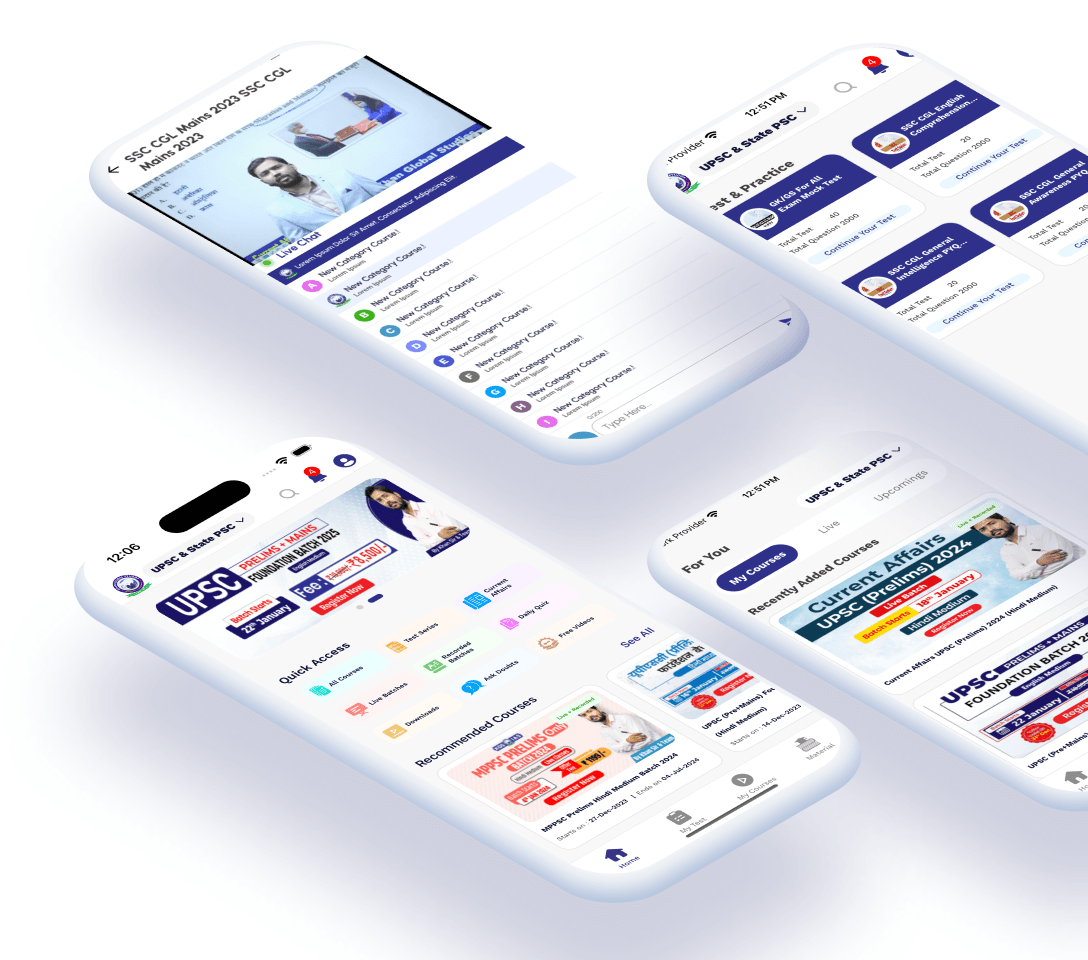
The most trusted learning platform on your phone
With our training programs, learning online can be a very exciting experience! Take the next step toward achieving your professional and personal objectives



NCERT Books
Resources
We love learning. Through our innovative solutions, we encourage ourselves, our teams, and our Students to grow. We welcome and look for diverse perspectives and opinions because they enhance our decisions. We strive to understand the big picture and how we contribute to the company’s objectives. We approach challenges with optimism and harness the power of teamwork to accomplish our goals. These aren’t just pretty words to post on the office wall. This is who we are. It’s how we work. And it’s how we approach every interaction with each other and our Students.
Come with an open mind, hungry to learn, and you’ll experience unmatched personal and professional growth, a world of different backgrounds and perspectives, and the freedom to be you—every day. We strive to build and sustain diverse teams and foster a culture of belonging. Creating an inclusive environment where every students feels welcome, appreciated, and heard gives us something to feel (really) good about.
Get Free academic Counseling & Course Details